How to Structure Your Workout Program (Part 1: Principles & Full Body Training)
Hey everyone! Following up from last week’s post on how to get started, I promised to dive deeper into the specifics of what to do – and I’m a man/woman of my word!
In Part 1 of this series, we’ll cover the overall principles of program design and then focus specifically on Full Body training.
The Core Principle: Maximizing Recoverable Volume
When I design a program for myself or my clients, my overarching goal is always the same: maximising training volume that allows for full muscle recovery.
What do I mean by volume? Simply put, it’s the number of sets you perform per muscle group. A common and effective starting point is aiming for 10-12 sets per muscle group per week. This often translates to training each body part about twice per week, which is a fantastic frequency for muscle growth.
Breaking Down Muscle Groups: From Simple to Specific
At a first glance, you might categorize muscle groups quite broadly. Imagine a simple list like this, where “Tally Count” represents sets per muscle group:
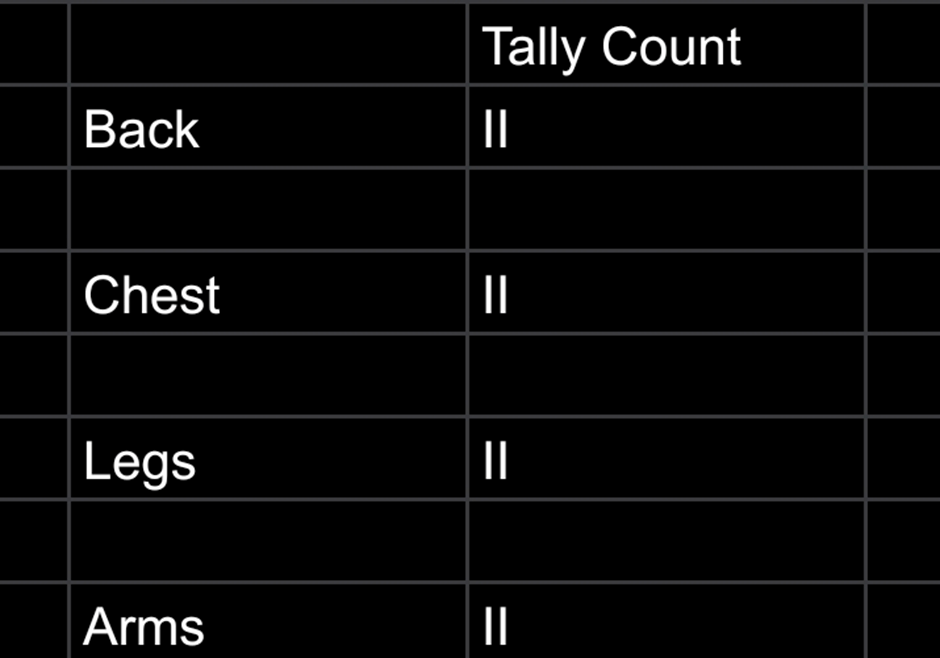
However, when you really start to dive into it, the picture becomes much more detailed. You begin to consider specific areas within those larger groups:
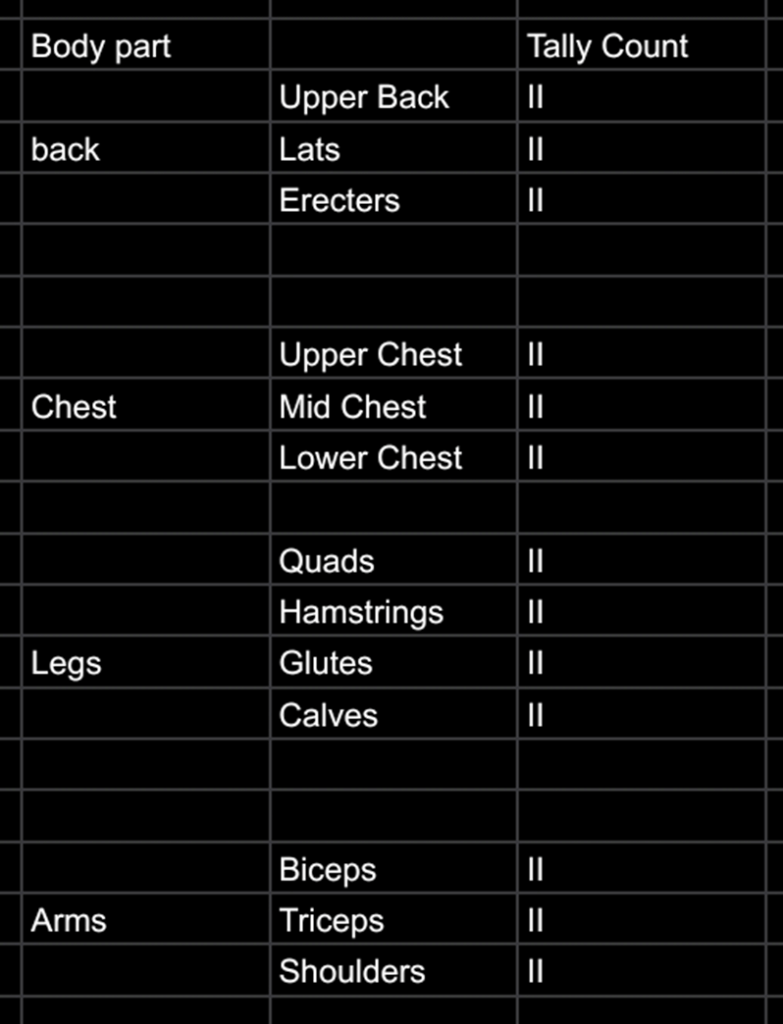
And if you’re truly looking to fine-tune the details and optimize every aspect of your training, the breakdown can get even more granular:
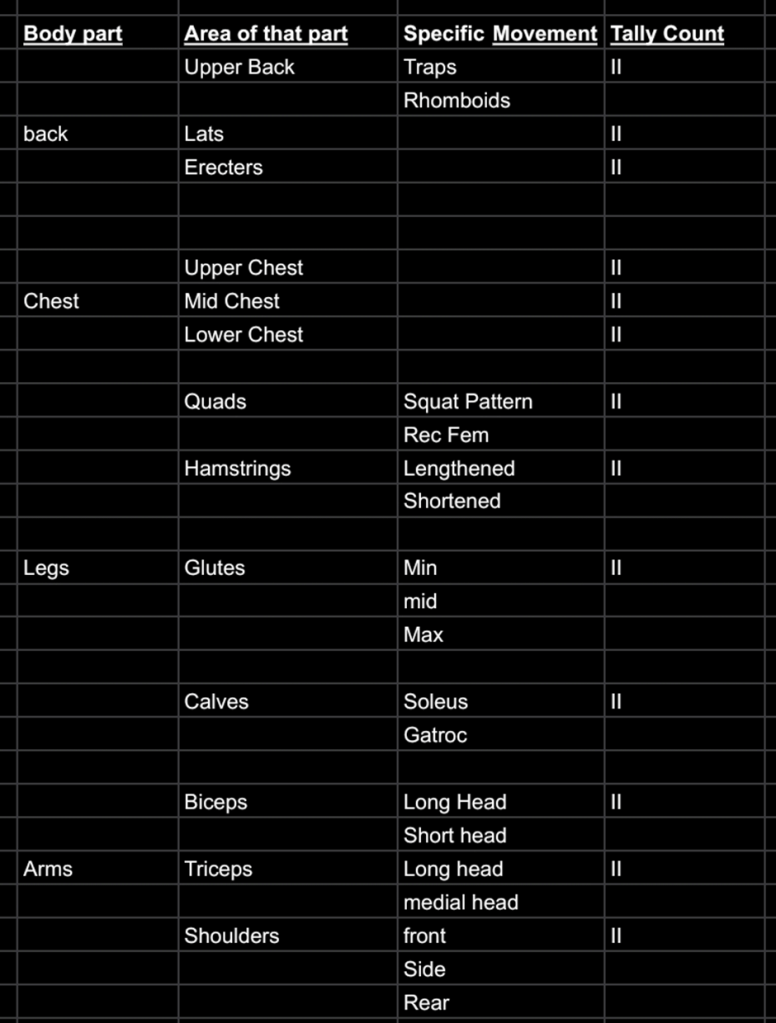
The good news? Most people don’t need to delve into the absolute deepest level of detail, especially when starting out. However, having more training days per week does allow you to give more attention to these finer points and specific muscle heads if that’s your goal.
A well-designed program will strategically place exercises to hit all these areas, either spread evenly for balanced development or with a specific purpose to bring up a lagging body part.
Example Program Considerations
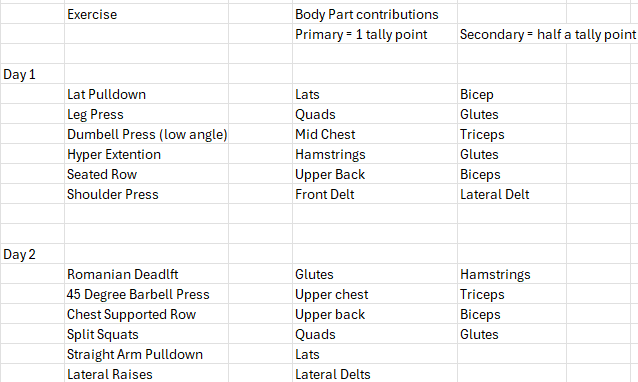
Yes, sometimes just 2 days repeated can be incredibly effective! Keeping things similar for a period is ideal for two main reasons:
- Measuring Progress (Improvement): Repeating exercises allows you to track your strength, reps, and overall performance over time.
- Battering Technique: Consistent practice refines your movement patterns and ensures you’re getting the most out of each exercise.
A few key principles for daily programming:
- Tough exercises first: Start your session with the most demanding compound movements when you’re freshest.
- Mix priorities: Don’t hit the same muscle groups hardest every single day. Rotate which areas are prioritized.
- Evaluate compound movements: While a “sets per muscle group” system is great, exercises that use a large amount of muscle groups (like the Romanian Deadlift or Squat) need a larger evaluation beyond just counting sets for one muscle. They contribute volume to multiple areas.
Understanding Muscle Recovery
Muscle recovery isn’t just about waiting a certain amount of time. It’s when you no longer feel significant soreness in that muscle and it feels ready to perform again.
For example:
- If you go to sit down and feel every inch of your glutes, they haven’t fully recovered yet.
- If you can’t comfortably reach up to the top shelf because your shoulder is still on fire, it hasn’t recovered yet.
Crucially: Don’t fall into the trap of thinking you have to wait a certain amount of time before hitting a muscle again if it genuinely feels ready. Listen to your body!
This goal of maximizing recoverable volume has a lot of variables, so let’s get right into one of the most important:
Days Per Week: Choosing Your Training Split
The number of days you can consistently train is perhaps the most important variable in program design. Below is my go-to split recommendation depending on how many days you can commit. This isn’t to say other options don’t exist, but we’re here to keep things simple and effective!
- 2 days a week: Full Body both days
- 3 days a week: Full Body each day
- 4 days a week: Upper Body / Lower Body (alternating days)
- 5 days a week: Upper Body / Lower Body (alternating days, perhaps with an extra upper or lower focus day, or a third full body workout)
- 6 days a week: Push Day / Pull Day / Leg Day (alternating, then repeat)
Note: I wouldn’t typically program or recommend training 7 days a week for most people. Even #teamnodaysoff needs strategic recovery!
Deep Dive: Full Body Training
Let’s focus on one of the most versatile and effective training styles: Full Body workouts.
What it Involves:
- Including at least one exercise for major muscle groups like Lats, Upper Back, Chest, Shoulders, Quads, and Hamstrings.
- Primarily utilizing compound movements – exercises that involve multiple muscle groups at once (e.g., squats, deadlifts, presses, rows).
- Sessions typically lasting around 60 minutes.
Pros of Full Body Training:
- Lower Time Investment: Just 2 or 3 sessions a week can yield fantastic results.
- Lower Recovery Demand: Spreading the volume means less intense individual muscle group fatigue.
- Great for Beginners: It builds a strong foundational strength base and movement patterns.
- High Frequency: You hit each muscle group multiple times per week, which is excellent for muscle protein synthesis.
Cons of Full Body Training:
- Longer Individual Sessions: Due to the higher number of exercises, individual workouts can be longer.
- Harder to Fit Niche Exercises: Limited time means you might not be able to include highly specific isolation exercises.
- Limited Muscle Growth Potential (for advanced trainees): For highly advanced individuals, overall volume per muscle group might be on the lower end compared to more specialized splits, potentially limiting peak growth.
Summary:
Full body training is absolutely amazing for beginners, those newer to training, and anyone with limited days to commit to the gym. While it might run into issues with longer sessions and not being able to delve into the absolute finest details of a program, its benefits for foundational strength and efficiency are undeniable.
Wow, this was a lot longer than I initially thought! But programming truly is a fine art, and I was 600 words deep before I realized it. Hopefully, this breakdown is clear and provides a solid foundation for you. Look forward to Part 2 next week, where we’ll explore other training splits and program variables!
 Sentinel Force Fitness
Leave a comment